Same day appointments Available | $99 New Patient Special Includes Exam and X-rays


By The Dentist Place of Clearwater | March 25, 2026
Who doesn’t want a better smile? We all long for a smile that will steal the hearts of the people around us. But only people who pay attention to their oral health can experience the satisfaction of owning their dream smile.
There might not be anyone who’s not bothered by staining from years of coffee, chips from an old injury, or teeth that have always made you feel shy/unconfident in photos. Cosmetic dentistry can change how you feel about your smile. But your road to this smile only widens when you take great care of your foundational oral care routine.
Your mouth needs to be in good health first to achieve the best results from cosmetic dental procedures. Not perfect, but stable. It’s the difference between cosmetic work that lasts and cosmetic work that fails within a year or two. Here’s why that foundation matters so much, and what it includes.
Cosmetic Dentistry Builds on What’s Already There
Every cosmetic procedure (veneers, dental bonding, clear aligners, gum contouring) attaches to, reshapes, or sits adjacent to existing teeth and gum tissue. If that existing structure is in poor condition due to decay, gum disease, or structural instability, any cosmetic work placed on top of it is built on a shaky base.
A cosmetic dentist will always run a full oral health assessment before recommending any elective treatment. Placing porcelain veneers over a tooth with untreated decay only traps the problem beneath and can lead to failure, infection, or the need to remove the restoration entirely.
What “Foundation” Means in Dental Terms
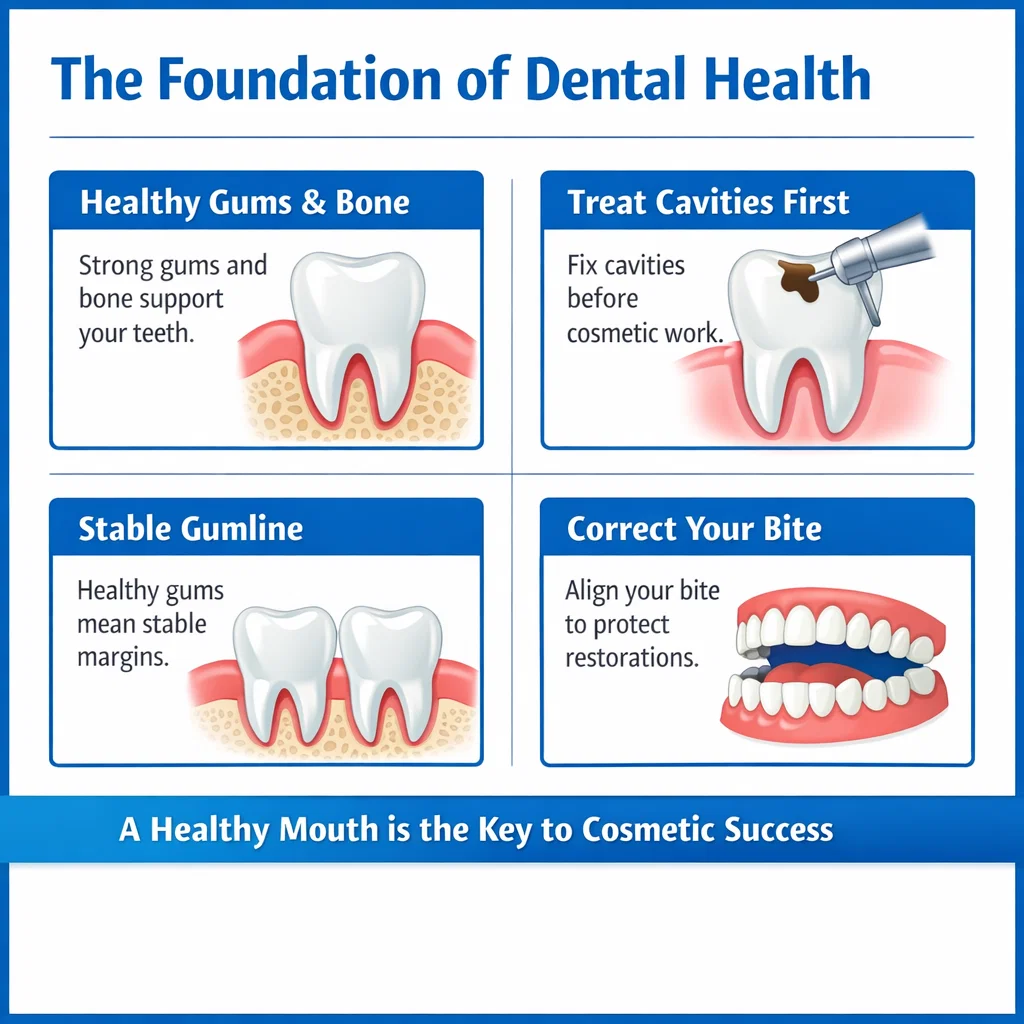
When dentists talk about oral health as a foundation, they’re referring to a few specific things. Gum health, bone stability, the structural integrity of your existing teeth, and the absence of active infection or disease. These aren’t aesthetic concerns — they’re the clinical conditions that cosmetic treatments depend on to function correctly.
Gum Disease Has to Be Addressed First
Periodontal disease is one of the most common reasons cosmetic treatment gets delayed. According to the CDC, close to half of American adults over 30 have some degree of periodontal disease. In its early stage, gingivitis is reversible. But even mild gum inflammation changes the shape of your gum tissue, which directly affects how cosmetic work is planned and how it looks once it’s placed.
Veneers, crowns, and bonding are all designed with a specific gum margin in mind. If that margin keeps shifting due to gum recession or inflammation, the appearance and fit of the restoration will change with it. Getting your gums stable before treatment means the cosmetic result is accurate and lasting.
Untreated Cavities Don’t Just Go Away
Active decay is a biological process. It doesn’t pause while you wait for a better time to deal with it. If there’s a cavity in a tooth that’s scheduled to receive a veneer or crown, the decay will continue progressing underneath or around the restoration. This leads to pain, structural damage, and eventually the loss of the restoration you paid for.
Treating cavities before cosmetic work isn’t an extra step. It’s protecting the investment you’re about to make.
Bite Issues Can Undermine Everything
Your bite (called your occlusion) describes how your upper and lower teeth come together. If there’s a misalignment, grinding habit (bruxism), or jaw dysfunction like TMJ disorder, any cosmetic work placed without addressing these factors is at higher risk of chipping, cracking, or wearing unevenly. Veneers are durable, but they’re not indestructible. A misaligned bite places stress on restorations, shortening their lifespan considerably.
Why Skipping Dental Health Care Costs More in the Long Run
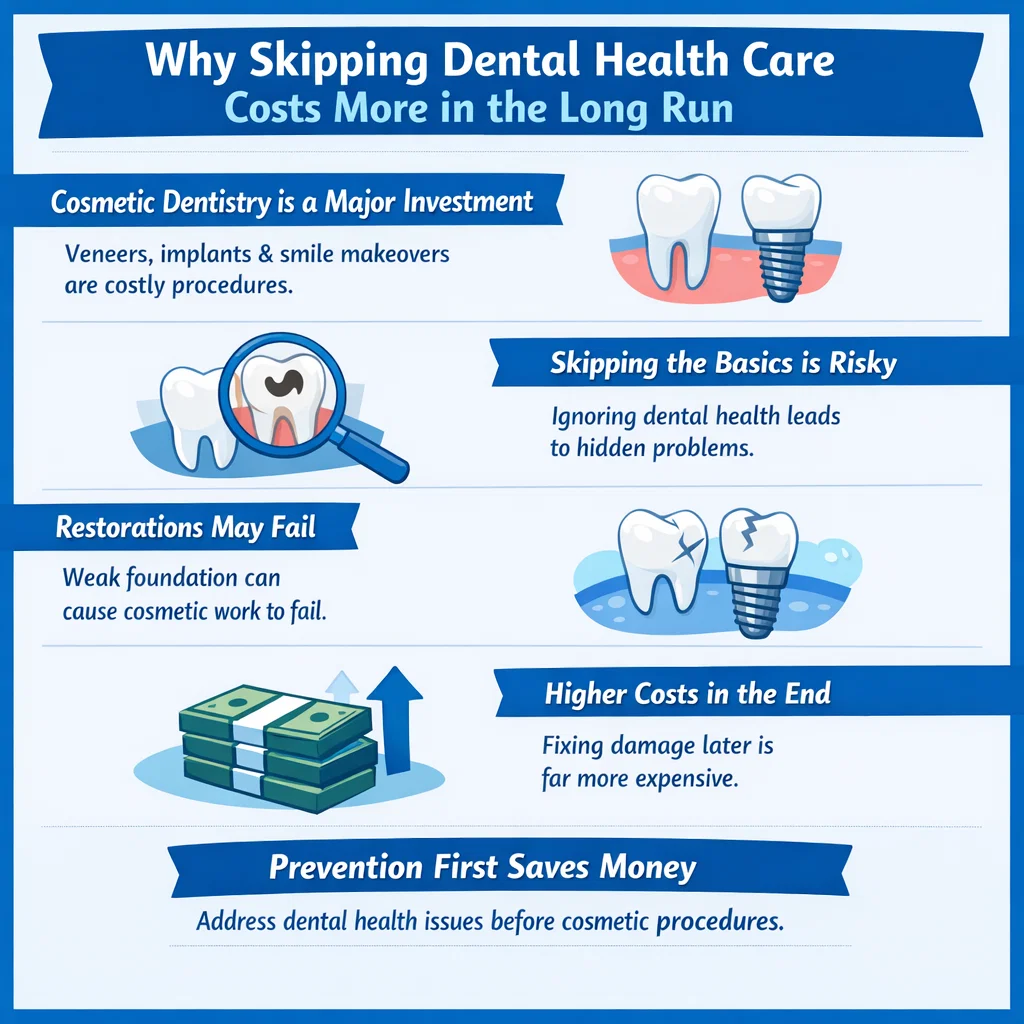
This is the part worth sitting with. Cosmetic dentistry is a real investment. Veneers, smile makeovers, and implant-supported restorations are not procedures you want to redo. When a patient bypasses the foundational work and goes straight to cosmetic treatment, the risk of failure increases sharply. The restoration fails, the underlying issue worsens, and the total cost of fixing both ends up being higher than it would have been if the dental health care had been done first.
What the Process Looks Like at The Dentist Place of Clearwater
Patients who come in for a smile consultation at The Dentist Place of Clearwater go through a thorough oral health evaluation first. That includes a clinical exam, X-rays to check bone levels and detect decay not visible to the naked eye, and an assessment of gum tissue health. From there, any issues that need to be addressed before cosmetic work proceeds are identified and explained clearly.
Some patients need nothing more than a professional cleaning and a touch-up on technique before they’re ready. Others may need a filling, a round of periodontal therapy, or a night guard to manage bruxism. The timeline varies, but the goal is always the same: get your mouth to a stable, healthy state so the cosmetic work has the best possible chance of lasting over time.
Signs You May Need Foundation Work Before Cosmetic Treatment
Not sure whether you’re ready for cosmetic work right now? These are the signs dentists look for:
- Bleeding gums when you brush or floss – a sign of ongoing gingivitis
- Tooth sensitivity that has developed or worsened recently, which can indicate decay or enamel loss
- Loose teeth or visible gum recession, which suggests bone or tissue loss
- A bite that feels off or teeth that are visibly wearing unevenly
- Pain when chewing or lingering soreness around a specific tooth
None of these rules out cosmetic treatment permanently. They just mean those issues need attention first so that the cosmetic work you receive is built on solid ground.
If you’ve been thinking about improving your smile, the right first step is an honest assessment of where your oral health actually stands. At The Dentist Place of Clearwater, consultations are simple – you’ll know what’s healthy, what needs attention, and what your realistic path to your cosmetic goals looks like. Call or request an appointment online.
People Also Ask
Q1: How long does it take to address oral health issues before cosmetic work?
It depends on what needs treatment. A single filling might take one visit. Periodontal therapy for gum disease typically takes two to four appointments over several weeks. Your dentist will give you a realistic timeline after the initial evaluation so you can plan accordingly.
Q2: Can I get teeth whitening if I have a cavity?
Whitening is generally not recommended over active decay. The bleaching agents can penetrate the damaged enamel and cause significant sensitivity or pain. The cavity should be treated first, then whitening can proceed safely on healthy tooth structure.
Q3: Will insurance cover the health-related work done before cosmetic treatment?
Dental insurance typically covers preventive and restorative work — like fillings, cleanings, and periodontal therapy — even when it’s being done as preparation for cosmetic treatment. The cosmetic procedures themselves are usually not covered. Your dental team can help clarify what applies to your specific plan.
Q4: Are there cosmetic procedures that don’t require a prior health evaluation?
All reputable dental practices require a health evaluation before cosmetic treatment. Even simple bonding or whitening involves first examining the teeth and gums. Any provider who skips this step is not practicing to the standard of care.
Q5: What happens if cosmetic work is placed over an untreated problem?
The underlying condition continues progressing. This can cause the restoration to fail, lead to infection, or damage surrounding teeth. In most cases, the restoration must be removed entirely to treat the issue properly, adding both cost and recovery time beyond what was originally planned.